
Data Analytics vs Data Science: Which Career Is Better in 2026? (Complete Guide) - Engineer Sahab Education

Christmas & New Year Get Upto ₹5000 on all courses

Get Offer

Valid Till: 14 January 2025

Data Analytics vs Data Science: Which Career Is Better in 2026? (Complete Guide)

Mar 13, 2026
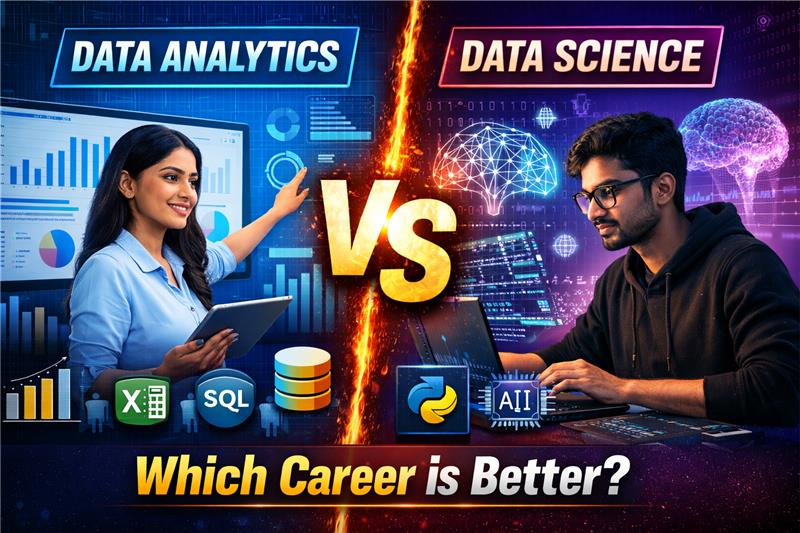
 

If you search on Google for “Data Analytics vs Data Science difference” or “Which career is better Data Analyst or Data Scientist?”, you will see thousands of students asking the same question.

With companies becoming more data-driven, careers in Data Analytics and Data Science have become two of the most in-demand technology jobs globally.

According to industry reports, the demand for data professionals is expected to grow more than 30% in the coming decade, making it one of the fastest-growing career fields in the world.

But many students are still confused:

Should you become a Data Analyst or a Data Scientist?

Which career offers better salary, easier entry, and long-term growth?

In this detailed guide, we will explain:

  • Difference between Data Analytics and Data Science
  • Required skills and tools
  • Salary comparison in India
  • Career opportunities and job demand
  • Which career is better for beginners


What is Data Analytics?

Data Analytics is the process of analyzing raw data to identify patterns, trends, and insights that help organizations make better decisions.

A Data Analyst works with historical data to answer questions like:

  • Why did sales drop last month?
  • Which marketing campaign performed best?
  • Which product category generates the highest revenue?

Data Analysts convert complex data into easy-to-understand dashboards, charts, and reports.


Key Responsibilities of a Data Analyst

  • Cleaning and organizing raw data
  • Analyzing datasets to find patterns
  • Creating dashboards and visual reports
  • Supporting business decision making
  • Presenting insights to stakeholders


Tools Used in Data Analytics

Some of the most popular Data Analytics tools include:

  • Microsoft Excel
  • SQL
  • Power BI
  • Tableau
  • Python (basic level)

In simple terms:

Data Analysts focus on understanding past data and explaining what happened.


What is Data Science?

Data Science is a more advanced field that combines statistics, programming, machine learning, and artificial intelligence to predict future outcomes using data.

A Data Scientist builds algorithms and predictive models that can forecast trends or automate decision making.

For example, data scientists help companies:

  • Predict customer behavior
  • Detect fraud in financial transactions
  • Recommend products on e-commerce platforms
  • Build AI systems and automation tools


Key Responsibilities of a Data Scientist

  • Developing machine learning models
  • Working with large datasets
  • Building predictive algorithms
  • Creating AI-driven solutions
  • Performing advanced statistical analysis


Tools Used in Data Science

Common Data Science tools and technologies include:

  • Python
  • R Programming
  • Machine Learning Algorithms
  • TensorFlow
  • Scikit-learn
  • Hadoop and Spark

In simple words:

Data Scientists predict what will happen in the future using data.


Data Analytics vs Data Science Salary in India

Salary is one of the biggest reasons why many students are attracted to data careers.


Average Salary of a Data Analyst in India

  • Freshers: ₹4 LPA – ₹7 LPA
  • Mid-level professionals: ₹8 LPA – ₹12 LPA


Average Salary of a Data Scientist in India

  • Freshers: ₹8 LPA – ₹15 LPA
  • Experienced professionals: ₹20 LPA+

Due to advanced skills in AI, machine learning, and statistics, Data Scientists generally earn higher salaries.

However, both careers offer excellent earning potential with experience.


Job Demand for Data Analytics and Data Science

The global economy is rapidly moving toward data-driven decision making.

Key industry statistics:

  • Data-related jobs are expected to grow around 34% in the next decade.
  • India is projected to require millions of skilled data professionals in the coming years.
  • Industries hiring data professionals include:
    • IT companies
    • Finance and banking
    • Healthcare
    • E-commerce
    • Marketing and advertising

This means both Data Analysts and Data Scientists will remain highly valuable in the job market.


Skills Required for Data Analytics

To build a career in Data Analytics, students should focus on learning the following skills.


Technical Skills

  • Excel for data analysis
  • SQL for database queries
  • Data visualization tools like Power BI or Tableau
  • Basic Python programming


Soft Skills

  • Business understanding
  • Communication skills
  • Analytical thinking
  • Problem solving

These skills help Data Analysts convert complex data into actionable business insights.


Skills Required for Data Science

Data Science requires a deeper technical skill set.


Technical Skills

  • Python or R programming
  • Statistics and probability
  • Machine learning algorithms
  • Data modeling
  • Big data technologies


Soft Skills

  • Research mindset
  • Critical thinking
  • Strong problem solving ability
  • Logical reasoning

Because Data Science combines programming, mathematics, and AI, the learning curve is typically more challenging.


Data Analytics vs Data Science: Which Career Is Better for Beginners?

For most beginners, Data Analytics is easier to start.

Reasons include:

  • Less programming required initially
  • Faster learning curve
  • More entry-level job opportunities
  • Can be learned in 6–8 months

Many professionals follow this career path:

Data Analyst → Senior Analyst → Data Scientist

Starting with Data Analytics allows beginners to build a strong data foundation before moving into advanced AI and machine learning roles.


Data Analytics vs Data Science: Which Should You Choose?

Your choice should depend on your interests and strengths.


Choose Data Analytics if:

  • You want a faster entry into the tech industry
  • You prefer working with dashboards and business insights
  • You enjoy analyzing trends and patterns
  • You want a career with moderate technical complexity


Choose Data Science if:

  • You enjoy mathematics and statistics
  • You want to build AI and machine learning systems
  • You love programming and solving complex problems
  • You want to work on advanced technologies

Both careers are future-proof because organizations across the world rely heavily on data-driven strategies.

© 2026 Engineer Sahab Education. All rights reserved.

Terms & Conditions | Privacy Policy
